
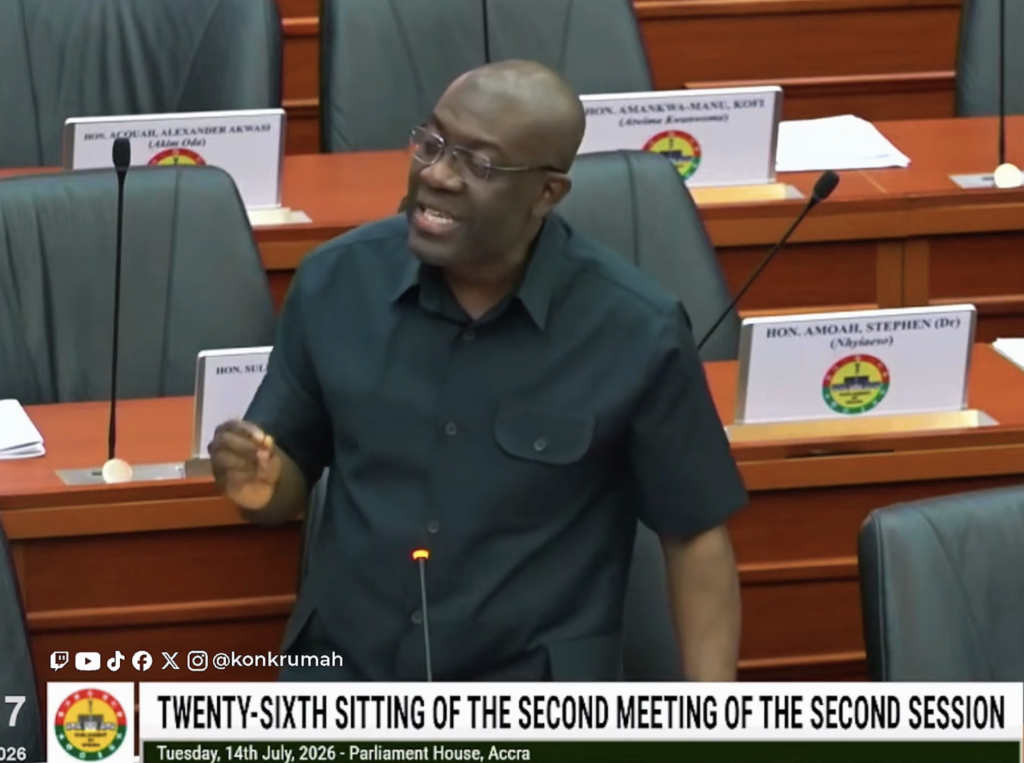
Parliament has approved close to GH¢650 billion over the past two years, yet the government cannot point to a single institution operating under its flagship 24-Hour Economy programme, the Ranking Member on the Economy and Development Committee has told Parliament.
Kojo Oppong Nkrumah, Member of Parliament for Ofoase-Ayirebi, observed while seconding a motion for the House to adopt the Committee’s report. He challenged the government’s industrial policy direction, arguing that the much-touted 24-Hour Economy has failed to deliver on its promises.
“The promise of the 24-hour economy was clear. One, three, three. One job, three people, three shifts,” Mr Oppong Nkrumah said.
“Almost two years on, after appropriating about 650 billion Ghana cedis, you cannot find one government agency that is applying one, three, three. That is the biggest testimony of the fact that this entire 24-hour economy programme that was so well marketed… at the end of the day, it is not delivering on what it was promised.”
The former Information Minister noted that the government has repeatedly been urged to present its major policy documents to Parliament but has only submitted the 24-Hour Economy policy aside from annual economic policy statements.
He criticised the administration for now shifting focus to constructing 24-hour markets and developing incentives for the private sector, describing these as unproven pillars of a policy that was sold to Ghanaians as a transformative economic solution.
Drawing from his constituency, Mr Oppong Nkrumah questioned whether building new markets would automatically create round-the-clock economic activity.
“There is already a market that has been constructed, like in many of our villages, which has to wait for one day in the week to function. What is the reason for which we believe that if we spend more money to build a new market, it will now function 24 hours?” he asked. “It beggars belief.”
The Ranking Member also criticised the government for admitting that the incentive framework expected to encourage private companies to adopt round-the-clock operations is still under development, nearly two years after taking office.
He argued this “betrays the priorities of this administration,” noting that while government has devoted attention to other legislative and judicial matters, the incentives that could make the flagship economic programme operational remain outstanding.
“Already you have worked on the tribunal’s bill that you have brought, because it is very important to you. Already, Mr. Speaker, you have removed the Chief Justice, because it is very important to you,” he said.
“But when it comes to the incentives that will now allow the private sector to possibly even work for 24 hours, assuming your model will work, the government tells us when we go for committee meetings that they are now working on those incentives. We think it betrays their priorities, and we think that they need to speed up.”
Mr Oppong Nkrumah further argued that the introduction of the 24-Hour Economy effectively displaced the One District, One Factory (1D1F) initiative, which, according to him, was already delivering measurable industrial outcomes.
Citing the National Development Planning Commission’s (NDPC) Annual Progress Report for 2024, published in June 2025, the Ofoase-Ayirebi MP said the official government document confirmed that at least 150 factories were operational under the 1D1F programme by the end of 2024.
“The policy architecture in place that would have given birth to a lot more has been removed, and now we are replacing it with a 24-hour economy policy, which is now, we are told, hinged on a 24-hour economy market and incentives that are yet to be birthed,” he said.
He warned that every day without a functioning industrial policy translates into lost employment opportunities for thousands of young Ghanaians.
Citing data from the Ghana Statistical Service, he said youth unemployment has risen to approximately 32.4 per cent, with nearly two million young people currently neither in education, employment, nor training.
“Every day that we stay without an industrial programme of this nature, which will incentivise the private sector to create more factories and create more jobs, every one of those days, the opportunity cost is hundreds of thousands of young Ghanaians who are sitting at home without jobs,” he said.
While supporting Parliament’s adoption of the committee’s report, Mr Oppong Nkrumah insisted that industrial transformation must move beyond campaign promises to measurable results that create factories, expand production and provide sustainable employment.
DISCLAIMER: The Views, Comments, Opinions, Contributions and Statements made by Readers and Contributors on this platform do not necessarily represent the views or policy of Multimedia Group Limited.
DISCLAIMER: The Views, Comments, Opinions, Contributions and Statements made by Readers and Contributors on this platform do not necessarily represent the views or policy of Multimedia Group Limited.
The post GH¢650bn spent in two years but 24-hour economy has no beneficiaries – Oppong Nkrumah appeared first on Ghana News Online.


